This is a little story about an antique mantel clock and how I came to own it. The short version is that I got it from Stan’s Aunt Helen who got it from her mother-in-law, Matilda Wishnefsky.
Now for the details.
Helen Kirsch Warren, was my mother-in-law’s younger sister. Although Helen was born in New York, her family moved to Paterson, New Jersey, in the 1920s. Abe and Helen met in New Jersey and married in 1946. They settled in Paterson not far from their families. They later moved to East Paterson. At 4’10” Helen was in constant motion and had a forceful personality. Abe, on the other hand, was tall, handsome, quiet, and easy-going. They could not have children, so they spent their days playing cards and the game of Rummikub at Westmont Pool Club where they belonged. They also loved to get dressed up and go out dancing. When they got older, they also loved to shop. They would purchase items one day and then return them the next. That kept them very busy! You can learn more about Helen at https://srothman.com/helen-kirsch-warren/

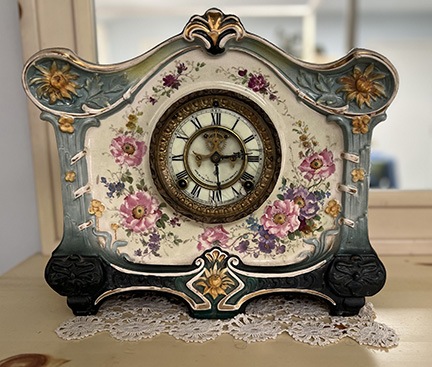
When I first met them in the mid 1960s, Helen and Abe lived in a second-floor one-bedroom apartment in East Paterson, New Jersey. They had to carry their dirty laundry up and down the stairs to take them to a laundromat for washing. Groceries also had to be carried up the stairs. As they got older, these things became more difficult. Helen packed up most of her knick-knacks so she would have less to dust, but the one item she kept out, was her antique mantel clock. As her siblings died or moved to Florida, they were left alone in New Jersey. We suggested they move to Connecticut to be near us and our boys whom they were quite fond of. In the late 1990s, they relocated to Cheshire, CT, bringing Mathilda’s clock with them.
We know that the clock first belonged to Matilda Wishnefsky, Abe Warren’s mother. According to the 1905 NJ State Census, Matilda was living in Paterson, New Jersey, but had arrived in this country around 1891. There are so many unanswered questions. Was the clock a wedding present to her? Did she first live in New York after arriving in this country, or was the clock sold in New Jersey where we know she lived? You can learn more about Matilda and her family at https://srothman.com/abe-warren/
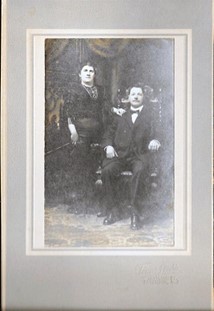
Matilda had two married sons, Jacob and Abraham. Did she give the clock to Helen, Abraham’s wife, or did Helen inherit it after Matilda died? We will never know that, either. I am wondering if Helen and her sister-in-law got along as after Jacob died, Helen and Abe lost contact with his brother’s family. Did Matilda favor Helen, or did Helen get the leftovers that her sister-in-law did not want after Matilda passed?
Helen’s beloved Abe passed away on October 12, 2000. She continued to live on her own in her condo in Cheshire Hillside Village in Cheshire, CT, a community of condos for people over 50. Helen made some good friends who took her shopping, and she also used the town’s senior bus to get to appointments. We helped out whenever we could, and my boys always took her out for lunch when they were home from college.
One afternoon during the summer of 2008, I visited Aunt Helen. I often stopped by to check in on her. She was now about 93 years old and suffering from congestive heart failure. As we talked that day, she mentioned to me that she wanted me to take home a mantel clock that she had in her bedroom. She said it had originally belonged to her mother-in-law, Mathilda Wishnefsky, and now she wanted me to have it. When it came time for me to leave, she did not mention the clock again, and I did not have the heart to admit to myself, or her, that I knew her end was near, so I left, not taking the clock with me.
Months later, after she passed, we had to clean out her condo. I remembered our conversation about the clock, so this time I took it home to honor her wishes. What was I going to do with it? I really had no room in my house for more “stuff”. However, as soon as I got home and walked into my bedroom, I immediately knew that was where it belonged. The porcelain cabinet with the teal, mauve, pink, off-white, and golden-yellow colors were the exact colors in my bedroom. The mantel clock now sits alone on the left side of my dresser, and I think of its story and the people who owned it before me whenever I look at it.
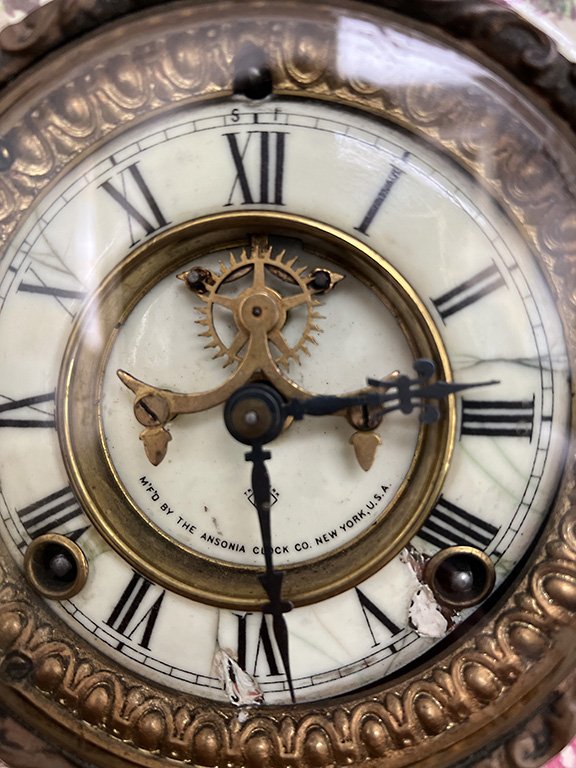
I was now curious about this clock I stared at every day. What was its history? Knowing that it belonged to Aunt Helen’s mother-in-law meant that it was from the early 1900s. If you look closely at the clock face, it says that it was manufactured by the Ansonia Clock Company of New York. With that piece of information, I could place when the clock was produced.
The clock company was founded in 1841 in Bristol, CT, under the name of Terry & Andrews. Clocks from that period have been stamped with “Terry & Andrews, Bristol”, or “Ansonia Clock Company, Ansonia”. In 1854, the company became known as the Ansonia Brass and Battery Company located in Ansonia, CT. Clocks from this period are usually labeled “Ansonia Brass Company”. In 1877, after another merger, the company was once again called the “Ansonia Clock Company”. However, a large factory had been built in Brooklyn, NY, and was in use by 1879. Over the years, the company has been sold and relocated due to factory fires and mergers.
“By January of 1883, Ansonia had sales offices in New York, Chicago, and London. By 1886, they offered 228 clocks and by 1914, this number had grown to almost 450! They had become especially known for their iron-cased clocks, often with white metal figurines, clocks with imported China cases and crystal regulators.” In the 1920s, most of the company’s assets were sold to Amtorg, a US trading company run by the Soviet government.” [1]
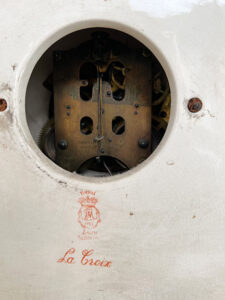
By peeking at the back of the clock, I learned that the hand-painted, porcelain China case on Aunt Helen’s clock was imported from the Royal Bonn of Germany. These cases were produced from 1836 – 1931 by the craftsman, Franz Anton. [2]
I could now date Aunt Helen’s clock. Based on its porcelain (China) cabinet and the stamp of Ansonia Clock Company, New York, it looks like it was produced after 1883.
The clock has no power. To make it work, someone would have had to wind it every day. Can’t you just picture Mathilda, or her husband, Joseph, diligently winding the clock each night before they went to sleep?
To wind it, they had to open the glass covering the clock face. Starting in the lower right hole, they would turn the key counterclockwise. They would turn until it would not turn anymore. Then they would put the key in the left lower hole and turn it clockwise until it would not turn.
Finally, to start the clock they would push the lever over the circle gear at the very top. That does not ensure the time, or the chime is correct, though. They might still have had to reset it.
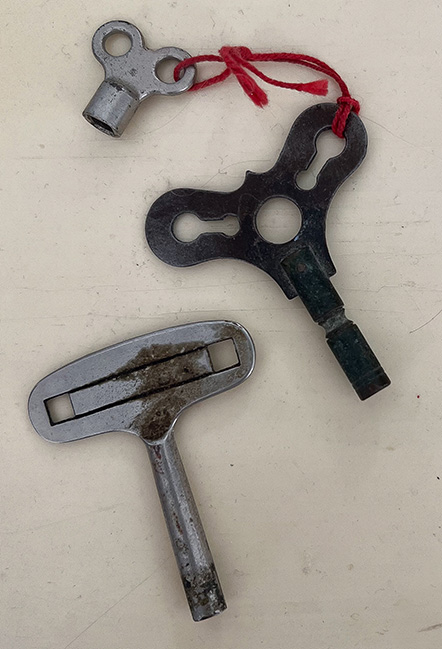
Mathilda or Joseph would have wound the clock conscientiously since that was the only way they would have known the time when they woke up. Remember, this was before the time of radios, which were not found in most homes until the 1930s. [3]
If only it could talk. What stories of the past we would all learn from it! It survived the Great Depression, two World Wars, the Vietnam War, the birth of Rock and Roll, the start of television, and the invention of air conditioning just to mention a few highlights. It witnessed family deaths and births, job changes, and relocations. If only the ticking of its hands, as they moved around the clockface, had been recording the sounds and images of its surroundings. What a tale it would tell!
Helen was an interesting character. She was a tiny little lady barely 4’ 10” tall but had a big personality. She could be aggressive and forceful but, in every conversation we ever had, she lamented the fact that she never was able to have children. I think both she and Matilda would be happy to know the clock still resides with family and through the clock, their memories and stories live on. However, I do regret not taking the clock when she offered it that day. Her mind would have been put to rest knowing that her treasured clock had a new home.
Sources
- [1]https://www.clockguy.com/SiteRelated/SiteReferencePages/AnsoniaHistory.html
- [2]Royal Bonn Porcelain History: https://www.clockguy.com/SiteRelated/SiteReferencePages/RoyalBonnHistory.html
- [3]How To Wind Your Ansonia Clock https://www.google.com/search?q=how+often+to+Wind+ansonia+mantel+clock+manual+&sca_esv=573232648&rlz=1C1VDKB_enUS1049US1049&biw=1920&bih=955&ei=hYEpZYLxAZXbptQPgIavsAg&ved=0ahUKEwjCx8CkyfOBAxWVrYkEHQDDC4YQ4dUDCBA&uact=5&oq=how+often+to+Wind+ansonia+mantel+clock+manual+&gs_lp=Egxnd3Mtd2l6LXNlcnAiLmhvdyBvZnRlbiB0byBXaW5kIGFuc29uaWEgbWFudGVsIGNsb2NrIG1hbnVhbCAyBRAAGKIEMgUQABiiBDIFEAAYogRI9FRQJliJSnAAeAKQAQCYAYcCoAHYEKoBBjExLjcuMbgBA8gBAPgBAcICBBAAGEfCAgUQIRigAcICCBAAGIkFGKIEwgIKECEYoAEYwwQYCsICCBAhGKABGMME4gMEGAAgQYgGAZAGCA&sclient=gws-wiz-serp#kpvalbx=__4EpZb2eJ7KnptQPyM2miAc_39
- The History of the Radio Industry in the United States to 1940.
- https://en.wikipedia.org/wiki/Ansonia_Clock_Company